What is PageFox, and who is it for?
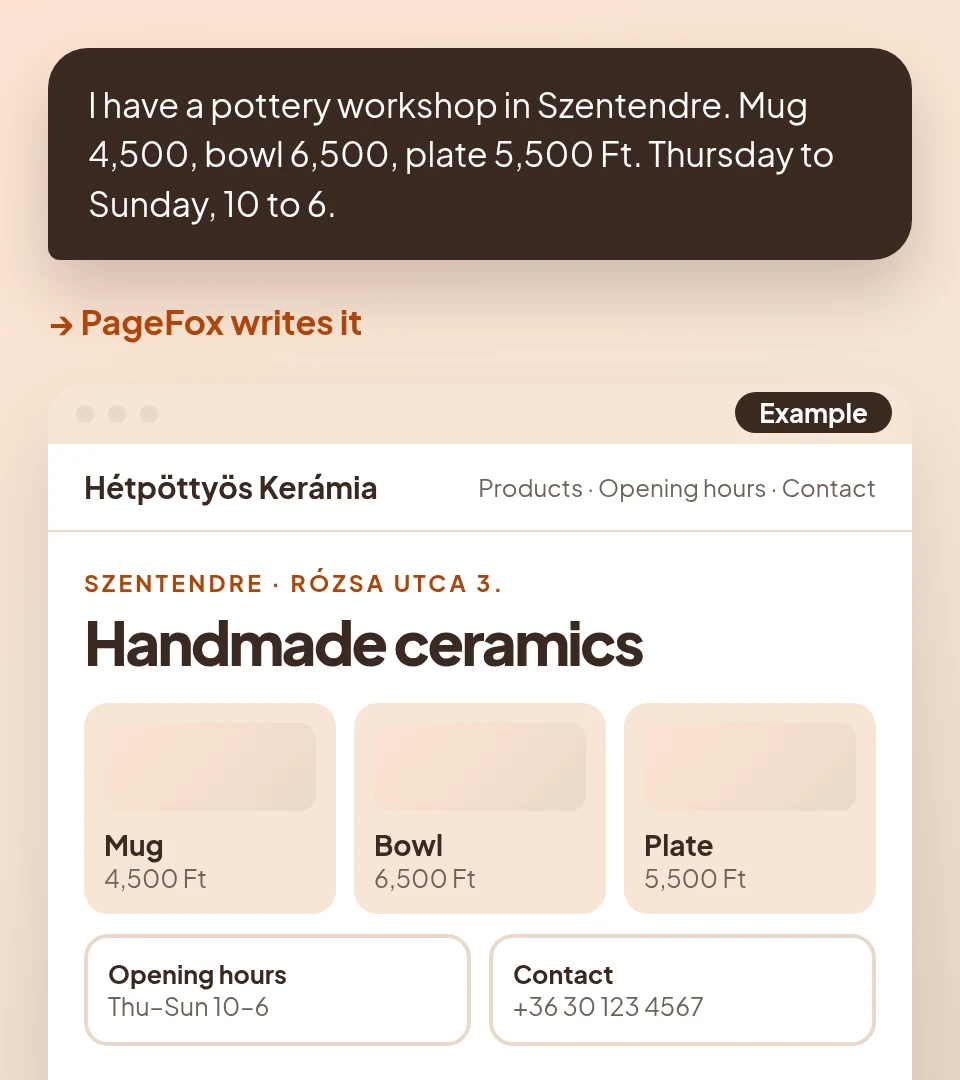
PageFox makes websites. Give the address of your current website, and it brings over
its pages, words and pictures; if you have no site yet, describe in plain words what
you would like, and it writes it. It is for anyone who needs a plain website without
an editor to learn: a local business, a tradesperson, a club, an event, or yourself.
You publish it at your own address, and you can take it with you any time.
Do I need any technical skills?
No. If you can say what you want on your page, that is enough. There is no editor to
learn, and no plugin to keep updated.
Why does PageFox not write a database and logins for your site?
On purpose: we started with websites, and we add every further feature carefully,
after thinking it through. Even the best AI makes mistakes sometimes. In a piece of
writing that is a trifle you notice and fix. Who can reach your visitors' data is
different: if the AI set it up right ninety-nine times out of a hundred, the
hundredth time your visitors' data could end up in the wrong hands, and you would
not notice it on a working screen. So we do not reinvent such parts site by site; we
provide them as ready-made building blocks: PageFox's specialists design them once,
we test them before every release, and your site simply uses them. The form is one
today; every further feature is made the same way.
What does PageFox not do?
It makes websites of words, pictures and links, with a contact form. What it does
not do today: accounts for visitors, a shop, a booking calendar or a database. If you
need one of those, we are not the right choice yet.
What is a credit, and what does a page cost?
A credit is the unit PageFox's work is counted in. Every request costs what the work
actually came to, and you see an estimate first. A first page has typically taken
60–110 credits so far, a small change
5–35. Asking for a lot at once costs more.
Changing your words yourself is free.
What does it cost a month?
You can start free: 200
credits to start, no card, and you can publish one page per site. The smallest
paid plan, Saját oldal, is 1,490
Ft a month (1,173 Ft + VAT), or
14,900 Ft a year. You pay in
forints and can cancel any time. Every plan's price is
with the prices above.
Can I move my WordPress site?
Yes. Give its address, and PageFox brings over the pages, words, pictures, styles
and fonts. What came over becomes your first version: publish it as it is, or keep
shaping it in plain words. There are no plugins to update after that. Bringing it
over is free; publishing a site of several pages takes a paid plan, as the Free plan
publishes one page.
Anything that ran on the old site's server, such as a shop, does not work here. You
can ask for a contact form, though: what visitors write in it is emailed to you.
My site is not on WordPress. Can I bring it over too?
Yes: give its address, just as for a WordPress site. If you have the site's files,
upload them as a zip: PageFox serves it just as you uploaded it. Either way,
bringing it over costs no credits; publishing a site of several pages takes a paid
plan, as the Free plan publishes one page.
Can I use my own domain?
Yes, on every plan, the free one included, at no extra cost. You register the domain
wherever you like; PageFox shows you what to set.
What happens to my site if I stop paying?
You go back to the Free plan: after
7 days on Saját
oldal and Alkotó, and on day
30 on Műhely and
Ügynökség, whose sites carry a notice that the plan is unpaid from day
14. As many of your
sites stay up as Free allows — you choose which — as you published them, every page,
with the PageFox band; what you publish on them next is one page. The rest pause,
and you can download them. Pay again before they are deleted and everything comes
back; if not, the paused sites are deleted. We write to you before anything is
deleted.
How do I take my site with me?
Download any version as a zip: plain HTML, CSS and image files that work with any
host. You do not need anyone's permission, and nothing is held back.
Can search engines read my site?
Yes: the words are in the page itself, so search engines and link previews
(Facebook, Messenger, WhatsApp) read them at once, and a sitemap is made too. Where
you appear in the results depends on your content; nobody can promise that.